The 20-ton CPT truck positions over the borehole point on a commercial site near West Dodge Road, its hydraulic rams engaging with the steady hum of a diesel engine. A cylindrical steel cone with a 60-degree apex and a friction sleeve just behind the tip is pushed into the Omaha ground at a constant rate of two centimeters per second. Unlike rotary drilling methods that retrieve disturbed samples, this electronic piezocone records tip resistance, sleeve friction, and pore water pressure every millimeter in real time. The data streams to a ruggedized field laptop inside the cab, where an operator monitors the continuous log as the probe descends through loess, glacial till, and weathered shale—stratigraphy that defines the geotechnical character of eastern Nebraska. For engineers working on the Missouri River floodplain or in the rolling terrain of West Omaha, this level of detail transforms foundation design from an exercise in interpolation into a precise, defensible process grounded in ASTM D5778 procedures.
CPT delivers a stratigraphic resolution of roughly two centimeters—no other mechanical in-situ test in Nebraska provides that density of geotechnical data per vertical foot.
Methodology and scope
Local considerations
The mistake we see repeatedly in Omaha's commercial construction sector is relying solely on SPT blow counts for foundation design in transitional soil profiles. An N-value of 12 in a moist loess looks adequate on a boring log, but that same soil can lose eighty percent of its bearing capacity under saturation—something the CPT cone identifies immediately through the friction ratio and pore pressure response. Without CPT data, a design team might specify shallow spread footings where ground improvement like rammed aggregate piers or deep foundations is actually needed. The cost of retrofitting a settled structure on the Creighton University campus or in the Aksarben Village redevelopment zone dwarfs the cost of a proper CPT investigation by an order of magnitude. We also encounter sites where contractors have stripped topsoil and compacted fill without documentation; the CPT sleeve friction trace reveals these undocumented layers unambiguously, letting the structural engineer adjust bearing elevations before steel goes in the ground.
Applicable standards
ASTM D5778-20, IBC 2021 Section 1803, Robertson (2016) CPT Soil Behavior Type classification, Boulanger & Idriss (2014) liquefaction triggering, ASCE 7-22 Chapter 20 site classification, Nebraska Department of Transportation NDOT Geotechnical Manual
Associated technical services
Standard Piezocone Testing (CPTu)
Continuous push to refusal or target depth with simultaneous measurement of corrected cone resistance, sleeve friction, and dynamic pore pressure. Includes friction ratio calculation, normalized soil behavior type charts per Robertson, and interpreted undrained shear strength for cohesive layers. Typical depths reach 40 to 80 feet in Omaha glacial till before encountering Pennsylvanian shale refusal.
Seismic CPT with Shear Wave Velocity
Same continuous profiling with a seismic adapter module behind the cone. At one-meter intervals we pause to record shear wave arrival from a horizontal hammer beam at surface. Produces a Vs profile for IBC site class determination and NEHRP amplification factors, essential for healthcare and essential facilities projects in Douglas County.
Typical parameters
Frequently asked questions
How deep can CPT push in Omaha soils?
Depth depends on the subsurface. In the Missouri River alluvium downtown we often reach 60 to 80 feet before hitting weathered Pennsylvanian limestone or shale. In the Peorian loess uplands west of 72nd Street, refusal typically occurs between 40 and 60 feet when the cone encounters dense glacial till or bedrock. The 20-ton reaction weight of the CPT truck provides the thrust capacity; sites with stiff, preconsolidated till may limit penetration sooner than soft floodplain clays.
What does CPT testing cost per foot in Omaha?
For standard CPTu work in the Omaha-Douglas County area, expect to budget between US$190 and US$270 per push, with the final figure depending on total linear footage, mobilization distance, and whether seismic shear wave measurements are included. A typical commercial site with three pushes to 50 feet apiece runs in that range. Seismic CPT adds a per-push surcharge for the geophone module and field technician time. We provide a written quote after reviewing the site address and project scope.
How does CPT compare to SPT borings for Omaha foundation design?
CPT provides a continuous, digital profile of soil behavior with millimeter-scale resolution, while SPT gives discrete blow counts every five feet from a disturbed sample. In Omaha's loess-over-till stratigraphy, CPT is far better at detecting thin sand seams, soft clay lenses, and the exact depth of the loess-till contact. SPT has the advantage of physical sample recovery for visual classification and lab testing. Many projects combine both: CPT for continuous stratigraphy and engineering parameters, with one or two SPT borings for material verification.
Can you perform CPT in tight access areas, like between existing buildings?
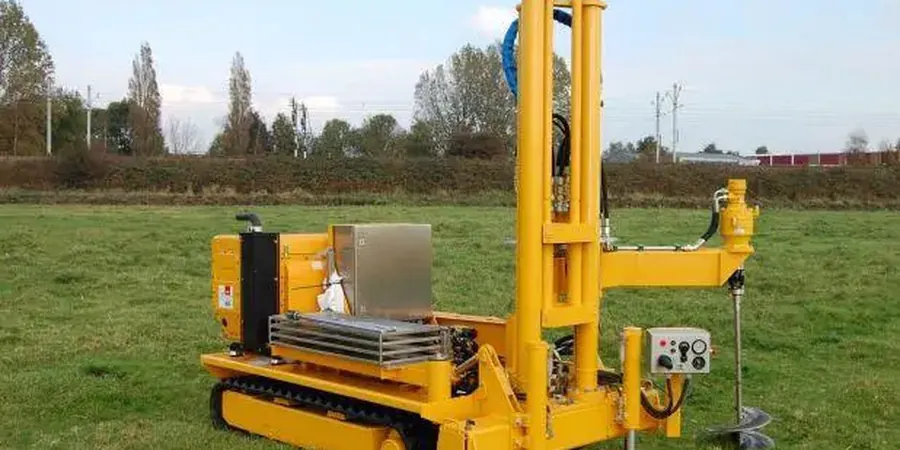
The full-size 20-ton truck needs approximately 12 feet of vertical clearance and a reasonably level working pad. For confined spaces—between buildings in the Old Market, inside existing warehouses, or on steep residential lots in the hills north of Dodge Street—we can deploy a modular CPT system mounted on a compact track carrier or anchored to a small skid. These setups push with 10 to 15 tons of reaction and still achieve good depths in most Omaha subgrades, though bedrock refusal may come slightly sooner than with the full truck. More info.