The difference between a site near the Missouri River and one up in West Omaha isn't just about the view. The alluvial silts and loose sands down by the river can lose bearing capacity fast, while the loess-covered uplands bring their own collapse risk when the moisture content shifts. That contrast forces us to approach each stone column design with a fresh set of eyes. We run the numbers through the Priebe method, pull field data from SPT borings, and size the columns so the reinforced ground can handle the load. It's a process built on local soil behavior, not a generic chart. When we need to check how inter-column fines will drain under repeated loading, we often pair the design with a triaxial test on remolded samples to confirm the friction angle assumptions before finalizing the column grid.
Stone columns don't just carry load. They drain, densify, and redistribute stress. In Omaha's loess, that triple role is what makes the difference between a slab that stays flat and one that cracks.
Methodology and scope
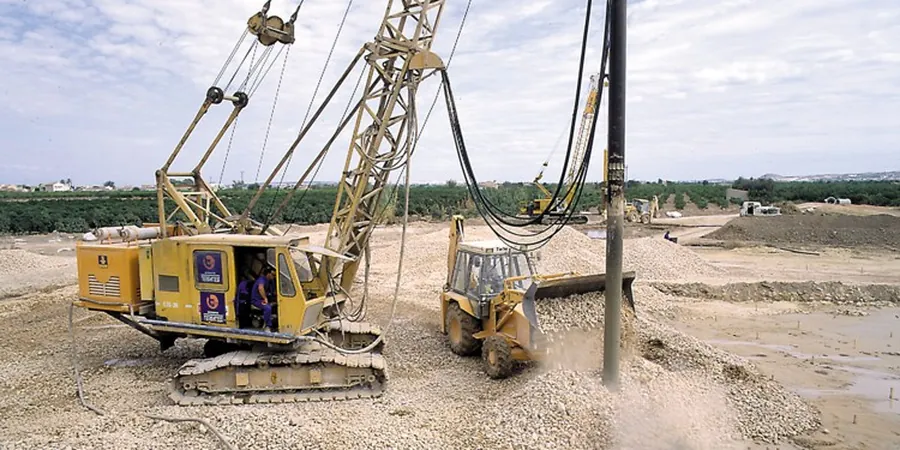
Local considerations
Omaha's freeze-thaw cycles and summer thunderstorms create a wet-dry pendulum that punishes poorly drained ground. When a stone column grid is undersized or the backfill gets contaminated with fines during installation, the drainage path clogs and pore pressure spikes under load. We've seen floor slabs heave after a wet spring simply because the columns couldn't shed water fast enough. Another exposure is column bulging in very soft clay. If the undrained shear strength drops below about 15 kPa, the stone can push outward instead of compacting the surrounding soil. We catch that early by running a few CPT soundings after the first test columns go in. The data tells us whether the spacing needs to tighten or the column diameter needs to go up before the production phase starts.
Applicable standards
ASTM D1586-18 (SPT for soil profiling), ASTM D2487-17 (USCS classification), IBC Chapter 18 (ground improvement provisions), FHWA-NHI-06-019 (Ground Improvement Methods, Vol. II)
Associated technical services
Stone column design package
We deliver column diameter, spacing, length, area replacement ratio, backfill spec, and load-test criteria. The package includes settlement and bearing capacity calculations per Priebe, with a column layout drawing keyed to the site grid.
Post-installation verification
Single-column and group load tests, plus CPT profiling between columns, confirm that the installed ground meets the design modulus. We compare pre- and post-treatment data and issue a signed verification report.
Typical parameters
Frequently asked questions
What's the cost range for stone column design in Omaha?
For a typical commercial or light industrial site, the design package runs between US$1,360 and US$4,490, depending on the number of borings, the column count, and whether load-test specifications are included. The fee covers the geotechnical analysis, the Priebe-method calculations, the backfill specification, and the production drawings with column layout.
How do you decide between vibro-replacement and vibro-displacement in Omaha's soils?
It comes down to the fines content. Vibro-displacement works well in loose sands and silts below about 12-15% passing the No. 200 sieve. When the fines are higher, we switch to vibro-replacement with a gravel backfill to maintain column integrity. We run a grain-size analysis on samples from each target layer before locking in the method.
Can stone columns replace deep foundations in the Missouri River floodplain?
In many cases, yes. If the soft layer is less than about 40 ft thick and the undrained shear strength stays above 15 kPa, a well-designed stone column grid can support spread footings and floor slabs directly. For deeper or softer deposits, we may combine columns with a load-transfer platform or recommend a hybrid solution.
How is the column length determined?
We set the tip elevation by identifying a competent bearing layer in the SPT or CPT logs. Columns extend at least 0.5 m into that layer. When the bearing stratum is too deep, we design a floating column grid and check settlement and bulging stability for the full soft-zone thickness.