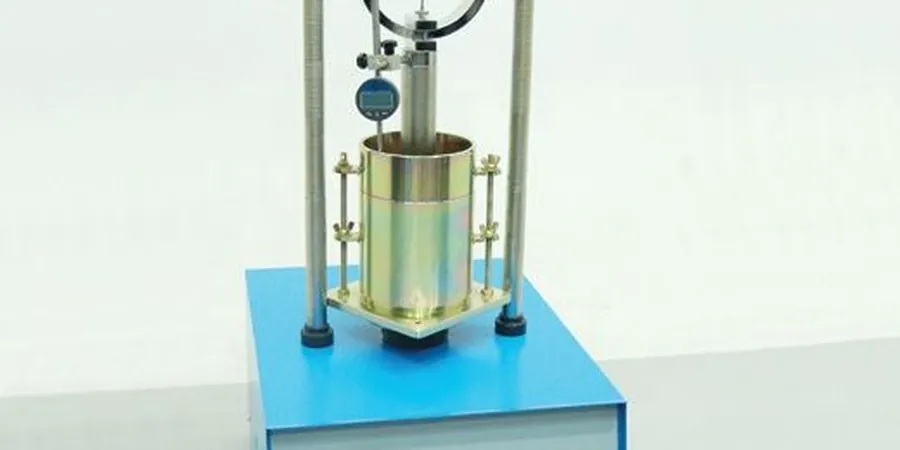
The difference between a parking lot off West Dodge Road that holds up for twenty years and one in the Old Market district that starts rutting after three winters often comes down to what sits beneath the asphalt. Omaha's subgrade conditions shift dramatically across the metro area—from the well-drained loess hills west of 72nd Street to the fat clays and alluvial silts along the Missouri River floodplain. A laboratory CBR test gives us a direct measurement of subgrade bearing capacity under controlled moisture and density conditions, which is something field tests alone cannot replicate when you are dealing with Nebraska's freeze-thaw cycles. We run these soaked CBR specimens in our climate-controlled lab, correlating the results with Proctor compaction data to establish the moisture-density-strength relationship that Omaha pavement designers need. For projects where the subgrade transitions from loess to clay within the same site, we pair CBR testing with grain-size analysis to map exactly where the bearing values change and where imported fill becomes necessary.
Omaha loess can lose over 40% of its bearing strength when saturated—soaked CBR testing reveals what dry-season field tests miss.
Methodology and scope
Local considerations
Omaha sits on a patchwork of Pleistocene loess deposits, Peoria Loess overlying glacial till, with thicknesses ranging from less than 5 feet near the Missouri River bluffs to over 60 feet in western Douglas County. This loess is metastable—it stands vertically when dry and unsaturated but collapses and loses bearing capacity rapidly when water infiltrates. A pavement designed using CBR values from dry-season sampling alone can underestimate the structural section by 30% or more, leading to premature fatigue cracking and subgrade rutting within the first five years. The water table in eastern Omaha, particularly in the Carter Lake and Florence areas, sits within 6 to 10 feet of the surface, which means soaked CBR testing is not optional—it is the only way to capture the worst-case subgrade condition that the pavement will experience during spring thaw. We have seen CBR values drop from 12% to below 4% after soaking in some of the fat clays near the Platte River bottoms, and when that happens, the pavement cross-section must be redesigned with either a thicker aggregate base course or a lime stabilization grouting treatment before placing the structural layers.
Applicable standards
ASTM D1883-21: Standard Test Method for California Bearing Ratio (CBR) of Laboratory-Compacted Soils, AASHTO T 193-22: Standard Method of Test for The California Bearing Ratio, ASTM D698-12(2021): Standard Test Methods for Laboratory Compaction Characteristics of Soil Using Standard Effort, ASTM D1557-12(2021): Standard Test Methods for Laboratory Compaction Characteristics of Soil Using Modified Effort, Nebraska Department of Transportation (NDOT) Pavement Design Manual – Section 3: Subgrade Evaluation
Associated technical services
Soaked CBR Testing (ASTM D1883)
Complete 96-hour soaked CBR on laboratory-compacted specimens with swell monitoring, surcharge application, and corrected stress-penetration curves for pavement structural design in Omaha.
Moisture-Density-CBR Correlation Studies
Testing across a range of moisture contents and compactive efforts to establish the relationship between field density, moisture condition, and bearing strength for NDOT and municipal projects.
Subgrade Resilient Modulus Estimation
Conversion of CBR values to resilient modulus (MR) using AASHTO and NCHRP correlations for Level 2 pavement design inputs, calibrated for typical Omaha loess and glacial till soils.
Swell Potential and CBR Combined Reports
Integrated reporting of swell percentage versus time during soaking, final moisture content, and CBR at multiple penetration depths for complete subgrade characterization under saturated conditions.
Typical parameters
Frequently asked questions
How much does a laboratory CBR test cost in Omaha?
A standard soaked CBR test on a single specimen typically runs between US$130 and US$200, depending on whether you need the full 96-hour swell monitoring with multiple dial readings per day. Most pavement projects require three specimens compacted at different moisture contents or densities, which brings the total to around US$390–US$600 for a complete set with the Proctor compaction data included. We provide a project-specific quote based on the number of samples and the turnaround time you need.
What is the difference between field CBR and laboratory CBR?
Field CBR testing uses a portable plunger pushed directly into the in-situ subgrade, which is quick but uncontrolled—moisture, density, and confinement conditions are whatever nature has provided on the day of testing. Laboratory CBR testing compacts the soil at a specified moisture content and density in a standard mold, then soaks it for 96 hours under a surcharge load that simulates the pavement weight, producing a worst-case saturated strength value. For Omaha's loess soils, which are highly moisture-sensitive, the laboratory soaked CBR is the number that governs pavement thickness design because it captures the spring-thaw condition that causes most failures.
How many CBR specimens do I need for a pavement design project?
The minimum recommended is three specimens per distinct soil type encountered on the site. Since Omaha projects often cross from loess uplands into alluvial lowlands, you may have two or three soil types requiring separate CBR evaluations—meaning six to nine specimens total. Each specimen is tested at the moisture content and density the project specifications require, and we recommend running at least one specimen at optimum moisture and one at wet-of-optimum to bracket the expected field conditions after construction.
What CBR value does NDOT require for road subgrades in the Omaha district?
The Nebraska Department of Transportation generally requires a minimum soaked laboratory CBR of 6% for subgrade soils under flexible pavements on state highways, though many municipal standards in Omaha and Douglas County use a 5% threshold for residential streets and 8% for arterial roads. If your soil tests below these values, the pavement design must compensate with a thicker aggregate base course, geosynthetic reinforcement, or soil stabilization—we provide the CBR data in a format that feeds directly into the AASHTO structural number calculation.