The first piece of equipment on site for a retaining wall assignment in Omaha is usually the hollow-stem auger drill rig, pushing through stiff Peorian loess to reach the glacial till or weathered shale beneath. In our experience across Douglas County, the design conversation starts not with the wall type but with the vertical cut the client needs and the lateral squeeze the soil will deliver. Omaha sits at the edge of the Missouri River bluffs, where loess thickness can exceed 60 feet in the Dundee area and drop to a thin veneer over limestone in South Omaha. That contrast demands a site-specific approach to footings and stem design, because bearing capacity on loess-derived silts behaves very differently from the sandy terrace deposits near Carter Lake. A wall that holds perfectly in a Keystone Trail subdivision may need a completely different reinforcement layout two miles east, where the water table rises within six feet of grade during spring melt. Our team combines SPT refusal data with laboratory consolidation curves to size the wall and select the right drainage aggregate before the first bucket of backfill arrives.
Omaha loess doesn’t fail by sliding — it fails by collapse upon wetting. Any retaining wall design here must control water before it controls earth pressure.
Methodology and scope
Reinforced segmental walls in Omaha subdivisions typically require geogrid lengths of 0.7 times the wall height, but that rule of thumb fails in the loess-bluff transition zones where the failure surface can exit through the slope rather than behind the reinforced mass. For those sites we run slope-stability back-analysis with pre-construction topography to confirm the reinforcement layout, and we specify crushed limestone drainage fill meeting Nebraska Department of Transportation gradation requirements to prevent clogging from silt migration.
Local considerations
The wall design challenges in the Happy Hollow neighborhood look nothing like those in the industrial flats near Eppley Airfield. Happy Hollow sits on thick loess that has been cut and filled over a century of residential development, creating perched water tables and undocumented fill that collapses under foundation loads. Walls here need deep keyed footings into undisturbed till and aggressive subdrain systems to intercept lateral flow. Down by the Missouri River, the problem reverses: sandy alluvium provides excellent drainage but poor bearing, and scour during flood events can undermine the wall toe. A 2019 project near the Bob Kerrey Pedestrian Bridge required a sheet-pile cutoff wall in front of the retaining structure specifically to address 100-year flood scour predicted by the USACE Omaha District hydraulic model.
Global instability through the wall and retained slope remains the most underestimated failure mode in Omaha. We have inspected walls where the designer checked overturning and sliding but never ran a circular failure surface through the reinforced zone, and the result was a slow rotational creep that cracked the facing panels within three freeze-thaw cycles. The city’s average 35-inch annual precipitation, concentrated in May and June, accelerates this mechanism. Any retaining wall design for Omaha must include a drained shear strength profile — not undrained — and a groundwater model calibrated to the highest observed level from the USGS monitoring well nearest the site.
Explanatory video
Applicable standards
IBC 2021 Chapter 18 (Soils and Foundations) — retaining wall prescriptive and performance requirements, ASCE 7-22 Section 15.6 (Earth Pressure) and Chapter 11 (Seismic Design Criteria), ASTM D698-12 (Standard Proctor) and ASTM D2487-17 (Unified Soil Classification System), AASHTO LRFD Bridge Design Specifications Section 11 (retaining walls for transportation projects), Nebraska Department of Transportation (NDOT) Standard Specifications for Highway Construction — retaining wall and drainage provisions
Associated technical services
Structural Retaining Wall Design and Analysis (Omaha IBC/NDOT)
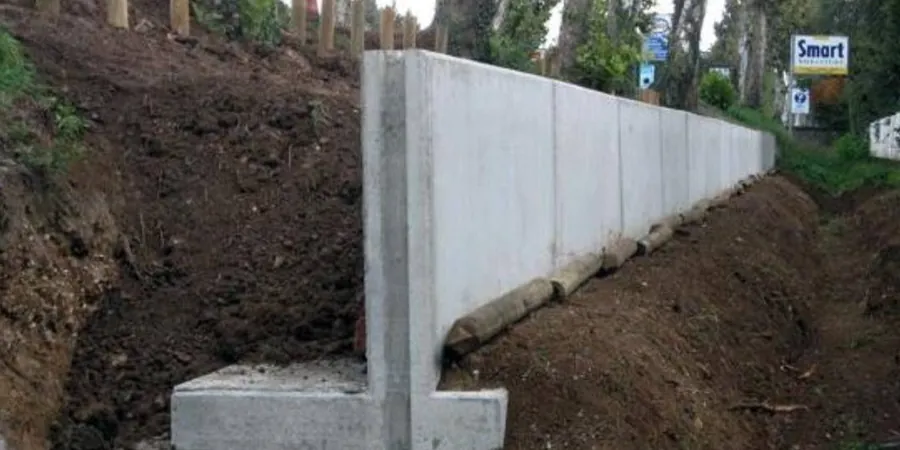
Complete design of cantilever, gravity, segmental (MSE), and anchored retaining walls including external stability checks (sliding, overturning, bearing), internal reinforcement design for MSE walls, and global slope stability verification. Deliverables include signed calculations, construction drawings, and drainage details suitable for City of Omaha permit submission and NDOT review when the wall is within state right-of-way.
Geotechnical Site Investigation for Retaining Wall Design
Subsurface exploration program designed specifically for retaining wall analysis: hollow-stem auger borings with SPT sampling to refusal, laboratory testing (direct shear, consolidation, Atterberg limits, grain-size distribution), and groundwater monitoring. The scope follows IBC 1803.5.5 requirements for walls over 6 feet and provides the drained strength parameters and stratigraphic cross-section needed for reliable lateral earth pressure calculations in Omaha loess and alluvium.
Typical parameters
Frequently asked questions
What is the typical cost range for a retaining wall design in Omaha?
Retaining wall design fees in Omaha typically range from US$1,010 to US$4,420, depending on wall height, complexity of the retained stratigraphy, and whether the wall requires global stability analysis. A straightforward segmental wall under 6 feet with simple soil conditions falls toward the lower end, while a cantilever wall over 12 feet on loess-bluff terrain with seismic analysis and drainage design reaches the upper portion of the range.
Do I need a retaining wall design if my wall is under 4 feet?
Under IBC 1803.5, walls retaining less than 4 feet measured from the bottom of footing to the top of wall are exempt from geotechnical investigation requirements provided they do not support a surcharge (such as a driveway or structure) and are not part of a tiered wall system. However, in Omaha loess, even a 3-foot landscape wall can experience distress if backfilled without drainage. We recommend at minimum a letter of geotechnical opinion for walls between 3 and 4 feet.
How do you handle the loess collapse potential in wall design?
Peorian loess in the Omaha bluffs is collapsible — meaning it loses volume rapidly when wetted under load. Our design sequence addresses this by specifying removal and recompaction of loess in the foundation zone to at least 3 feet below the wall footing, combined with a geogrid-stabilized backfill wedge that bridges any differential settlement. We also run hydroconsolidation potential testing (ASTM D5333) on undisturbed Shelby tube samples to quantify the collapse strain and adjust the bearing pressure accordingly.
What drainage provisions does an Omaha retaining wall require?
Every retaining wall we design for Omaha includes a continuous drainage system: a 12-inch minimum width of free-draining crushed limestone behind the wall stem, a 4-inch perforated collector pipe at the base, and a filter fabric wrap meeting AASHTO M288 Class 2 retention criteria to prevent silt migration from the surrounding loess. For walls over 8 feet, we add intermediate drainage blankets at vertical intervals of 6 to 8 feet. The system must daylight to a positive outfall — we coordinate with the site civil engineer to confirm the outlet elevation works with the stormwater plan.