A five-story mixed-use project near the Old Market district ran into a permitting delay because the geotechnical report assumed uniform Site Class D across the entire parcel. The eastern half of the lot sits on Missouri River alluvium thicker than 30 meters, while the western edge hits glacial till at less than 15 meters. That two-letter site class difference changes the short-period spectral acceleration by nearly 40 percent under ASCE 7-22. Seismic microzonation resolves exactly this kind of spatial variability before structural drawings are locked. In Omaha, where the bedrock surface drops from roughly 300 feet near the Missouri River bluffs to over 600 feet downtown, mapping the site period and Vs30 across a project footprint is not a theoretical exercise. It is a direct input to base shear, drift limits, and foundation proportioning. When site conditions change within a single block, a single borings log cannot tell the full story. Our team combines surface-wave geophysics, downhole logging, and existing NEHRP site class data to produce maps that the structural engineer can actually use. The output ties directly to the IBC Section 1613 ground motion tables and the USGS National Seismic Hazard Model.
Two buildings 200 feet apart can see a 35% difference in spectral acceleration if one sits on rock and the other on 40 feet of alluvium.
Methodology and scope
Local considerations
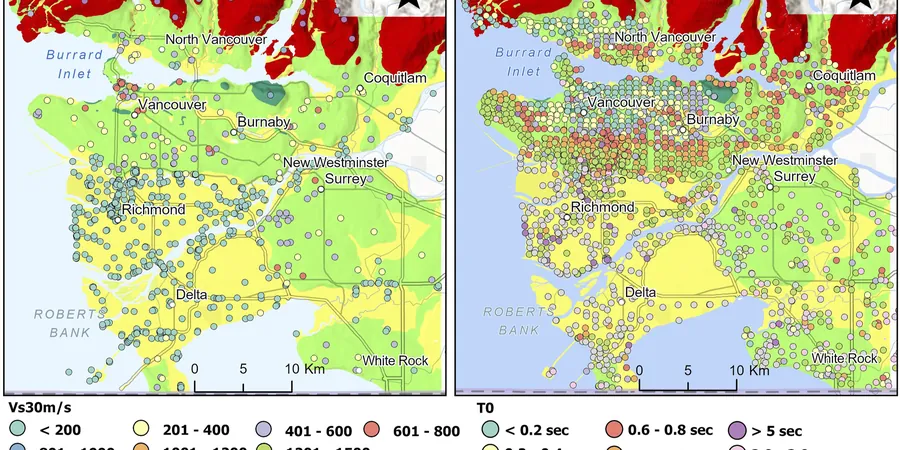
ASCE 7-22 Section 11.4.8 requires site-specific ground motion analysis when Site Class F soils are present or when the structure is assigned to Risk Category III or IV on a site classified as D or E with S1 exceeding 0.20g. In Omaha, S1 at the 2% in 50-year hazard level is approximately 0.08g, which keeps most ordinary buildings below the mandatory trigger. However, the code's trigger is a minimum threshold, not a best-practice ceiling. The real risk is unaccounted spatial variability. A 0.3-second difference in site period between two adjacent column lines can amplify drift demands beyond what a uniform-hazard spectrum predicts, especially for mid-rise structures with periods between 0.5 and 1.5 seconds. Deep loess deposits in western Douglas County amplify long-period energy in a way that standard short-period amplification factors do not capture. Microzonation also identifies edge effects where the impedance contrast between weathered shale and overlying soil creates lateral propagation that can concentrate strain in foundation slabs. These are not code-default checks; they require site-specific measurements and numerical ground response analysis.
Applicable standards
ASCE 7-22 Minimum Design Loads, IBC 2024 Section 1613 Earthquake Loads, ASTM D7400-19 Downhole Seismic Testing, NEHRP Recommended Seismic Provisions (FEMA P-2091)
Associated technical services
Vs30 Mapping and Site Class Delineation
MASW lines and downhole seismic surveys to map shear-wave velocity across the project footprint. Output includes GIS polygons with ASCE 7 site class boundaries and tabulated Vs30 values for direct input into structural models.
Ground Response Analysis
One-dimensional equivalent-linear or nonlinear site response analysis using DEEPSOIL or equivalent software. Acceleration time histories are scaled to the USGS Unified Hazard Tool for Omaha coordinates. Provides surface spectra, amplification factors, and strain-compatible soil properties.
Liquefaction Potential Mapping
Screening-level and quantitative liquefaction assessment using SPT and CPT data integrated with Vs profiles. Maps of LPI and post-liquefaction settlement are overlaid on the microzonation grid to identify zones requiring ground improvement or deep foundations.
Typical parameters
Frequently asked questions
Is site-specific ground response analysis mandatory in Omaha?
For most buildings under Risk Category I or II on Site Class C or D, ASCE 7 does not mandate it because Omaha S1 values are below the 0.20g trigger. However, the City of Omaha Building Department may request a microzonation study when site conditions change sharply across a parcel, or for essential facilities such as hospitals, fire stations, and emergency operations centers.
How many MASW lines does a typical microzonation require?
A standard commercial lot of one to three acres usually needs three to five MASW lines spaced 75 to 100 feet apart, plus one downhole seismic test paired with an existing boring for calibration. Larger industrial sites or linear infrastructure corridors require proportionally more coverage. The exact layout is designed after reviewing the preliminary boring logs and the site geology map.
What do seismic microzonation services cost for an Omaha project?
For a mid-size commercial site in the Omaha metro area, seismic microzonation typically ranges from US$3,650 to US$15,610 depending on the number of geophysical lines, whether downhole seismic logging is included, and if nonlinear ground response analysis is required. A detailed proposal is provided after reviewing the site plan and existing geotechnical data.
Can you use existing boring logs for the microzonation?
Existing borings provide valuable stratigraphic control, especially when they include SPT N-values and laboratory classification data. We use them to constrain the soil layering in the ground response model. However, Vs measurements from geophysical testing are still required because empirical correlations between N-value and shear-wave velocity have high scatter in Nebraska glacial soils and loess. More info.