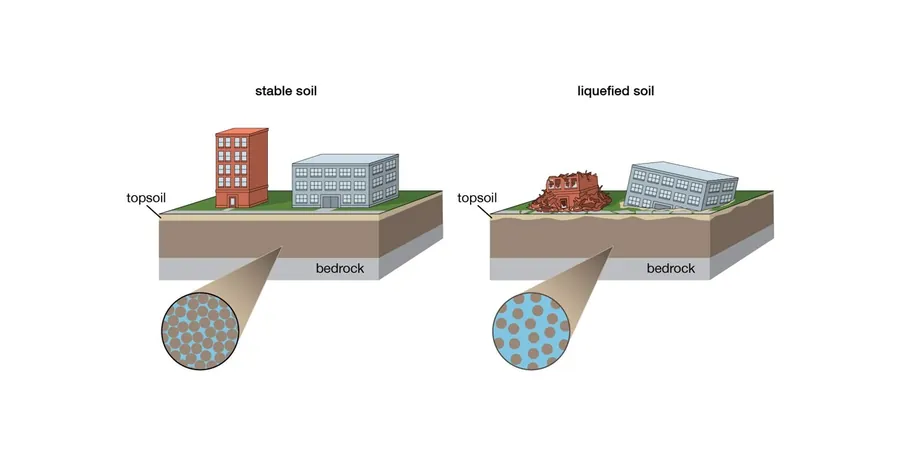
In Omaha, we often see project owners surprised by how much the Missouri River’s old floodplain can influence foundation design. The sand and silt deposits beneath neighborhoods like Dundee or the Old Market aren’t just loose fill—they’re materials that can lose strength fast when saturated and shaken. Our liquefaction analysis goes beyond a simple SPT blow count. We correlate field data with the site’s seismic hazard, looking at groundwater depth, fines content, and soil density to determine if the ground will behave more like a liquid than a solid during an earthquake. For deeper profiling where continuous data is essential, the CPT test gives us a nearly uninterrupted record of tip resistance and pore pressure, helping to pinpoint thin liquefiable layers that standard drilling might miss.
Understanding whether your Omaha site sits on old floodplain sands or stiff glacial till changes the entire foundation strategy—and the project’s long-term insurance profile.
Methodology and scope
Local considerations
With a population of roughly 486,000 in Omaha proper and major infrastructure like Offutt Air Force Base just to the south, the seismic risk here isn’t theoretical. While Nebraska isn’t California, the Nemaha Uplift and the Humboldt Fault Zone generate real—if infrequent—shaking. A magnitude 5.0 event near the Platte River could easily trigger lateral spreading along the Missouri River banks if the underlying sands are liquefiable. The cost of ignoring this risk shows up later: differential settlement, cracked slabs, and underground utilities that shift and shear. For critical facilities, we also evaluate post-liquefaction reconsolidation settlement, which can add several inches of vertical movement that wrecks floor grades and pipe connections. A proper liquefaction analysis isn’t a line item expense—it’s a safeguard against structural repairs that cost ten times the initial study.
Applicable standards
ASCE 7-22, ASTM D1586-18, NCEER Workshop Report (Youd-Idriss 2001), ASTM D2487-17, ISO/IEC 17025:2017
Associated technical services
Standard Liquefaction Screening
A targeted evaluation using SPT blow counts and lab grain-size data to compute factors of safety for each layer. Ideal for commercial buildings and preliminary site due diligence in the Omaha metro.
Advanced Post-Liquefaction Analysis
Includes settlement estimates, lateral spreading displacement calculations, and mitigation feasibility. Designed for critical infrastructure, bridge approaches, and tall structures where performance-based design is required.
Typical parameters
Frequently asked questions
How much does a liquefaction analysis cost for a typical Omaha commercial lot?
For a standard commercial site in the Omaha area, a complete liquefaction analysis including field drilling, SPT testing, and laboratory classification generally runs between US$2,450 and US$4,440. The final figure depends on the number of borings, depth to groundwater, and whether advanced settlement calculations are needed.
Is liquefaction really a concern in Omaha, given the low seismicity?
Yes, particularly along the Missouri River floodplain and near the Platte River confluence. The combination of shallow groundwater, loose Holocene sands, and moderate seismic sources like the Nemaha Uplift creates conditions where liquefaction can occur. The IBC and ASCE 7 require evaluation when these soil and water conditions are present, regardless of the perceived seismicity.
What’s the difference between a screening and a full post-liquefaction settlement analysis?
A screening tells you whether the soil is likely to liquefy—essentially a factor of safety for each layer. A full post-liquefaction analysis goes further: it estimates how many inches the ground will settle after shaking stops, using volumetric strain correlations from Zhang et al. (2002). For structures sensitive to differential movement, like warehouses with slab-on-grade or buildings with mat foundations, that settlement number directly drives the engineering decision.