Omaha’s development from a Missouri River trading post into a modern Midwestern hub has created a patchwork of foundation conditions. The deep loess deposits blanketing the bluffs can collapse when wetted, while the underlying glacial till provides variable bearing capacity. These contrasts make a thorough geotechnical investigation the only reliable starting point for a raft or mat foundation design. Our laboratory, holding ISO/IEC 17025 accreditation for soil classification, runs a complete suite of index and strength tests to feed into the structural analysis. In areas near the river floodplain, where soft alluvial clays extend more than 20 feet, we often integrate CPT soundings to map the transition between compressible layers and competent bearing strata without disturbing the sample.
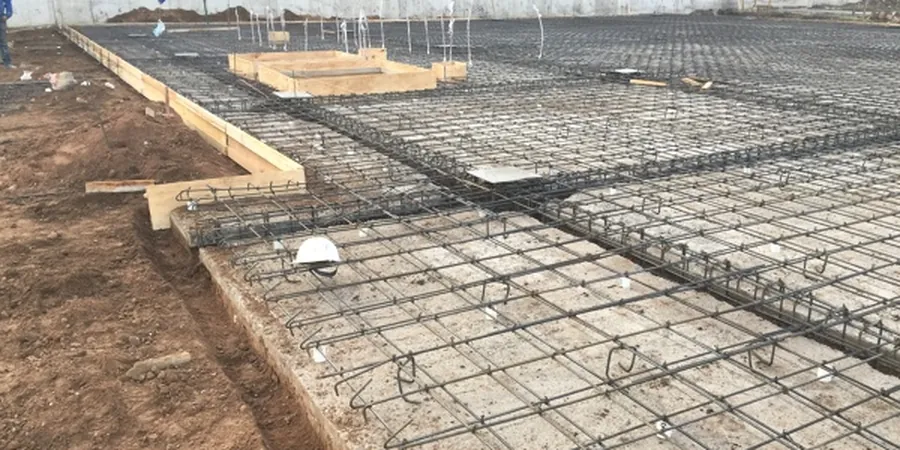
A mat foundation on Omaha's loess requires not just bearing capacity but a rigorous settlement analysis: differential movement, not total load, typically governs the design.
Methodology and scope
Local considerations
A common mistake local contractors make is pouring a uniform-thickness mat over uncompacted fill without a site-specific geotechnical report. In West Omaha subdivisions, the original loess surface is often cut and recompacted, but undocumented fills from the 1960s and 1970s lack density control. A mat founded on these materials can experience edge curl and interior cracking within the first five years as deep-seated consolidation progresses. The repair costs routinely exceed the original foundation budget. A proper design sequence includes a proof-roll observation, nuclear density testing on the prepared subgrade, and a settlement analysis that accounts for the fill’s stress history. Ignoring this sequence turns a mat foundation, which should distribute loads uniformly, into a rigid slab bridging soft pockets it was never designed to span.
Applicable standards
IBC 2024 (Nebraska edition), ASCE 7-22 Minimum Design Loads, ASTM D2435 / D4767 (consolidation and triaxial), ACI 360R-10 Guide to Design of Slabs-on-Ground
Associated technical services
Subsurface Exploration Program
We design and execute a drilling and CPT campaign tailored to the mat footprint, targeting the full depth of influence. The program defines layer boundaries, groundwater conditions, and sample recovery for lab testing.
Advanced Laboratory Testing
Our ISO 17025-accredited lab runs one-dimensional consolidation, CU triaxial, and Atterberg limits on undisturbed Shelby tube samples. These parameters are essential for the settlement and bearing capacity models.
Settlement and Bearing Capacity Analysis
Using finite-layer summation and elastic half-space methods, we compute total and differential settlement under the mat's structural loads. The output is a subgrade reaction modulus map for the structural engineer.
Construction-Phase Subgrade Verification
We provide full-time observation during subgrade preparation, including density testing and proof-rolling, to confirm the as-built conditions match the design assumptions before the mat is poured.
Typical parameters
Frequently asked questions
When is a mat foundation preferred over isolated footings in Omaha?
Mats are recommended when the bearing stratum is competent but differential settlement between isolated footings would exceed 1/2 inch. They also work well on the loess hills where deep fill makes individual footings impractical. The mat bridges minor soft spots and reduces the risk of structural distortion in masonry-bearing walls.
What does a mat foundation design evaluation cost in the Omaha area?
For a typical single-family or light commercial mat foundation in Douglas County, the geotechnical evaluation, including drilling, lab testing, and the engineering report, generally ranges from US$1,090 to US$4,200. The final figure depends on the number of borings, the testing suite required, and the complexity of the settlement analysis.
How does the local loess soil affect a mat foundation?
Loess is a wind-deposited silt that can lose significant volume when saturated. Our design process includes a collapse-potential evaluation using ASTM D5333. If the loess is collapsible, we either require pre-wetting and compaction or design the mat with sufficient reinforcement to span localized collapse zones.
What seismic provisions apply to mat foundations in Omaha?
Although Nebraska is a moderate seismic region, ASCE 7-22 still requires a site-specific seismic design. For mat foundations, this means checking the bearing capacity reduction under cyclic loading and evaluating liquefaction potential in saturated sandy silts below the groundwater table. The mat thickness and reinforcement are then adjusted to accommodate any predicted ground softening.