A 20-ton hydraulic excavator digs a clean vertical face through loess and glacial till right on your Omaha site. That is the core of an exploratory test pit—direct observation without the ambiguity of disturbed samples. We open trenches typically 3 to 5 feet wide and up to 14 feet deep, enough to expose the contact between the Peoria Loess and the underlying glacial deposits that characterize much of Douglas County. The field geologist logs strata in place, measures in-situ density with a sand cone at target depths, and collects bulk samples for laboratory grain-size analysis when finer classification is required. For projects east of 72nd Street where fill thickness varies unpredictably, we often run a CPT sounding nearby to correlate continuous tip resistance with the visual profile from the pit.
Seeing a 14-foot vertical face in Omaha loess tells you more about collapse potential than any SPT number alone.
Methodology and scope
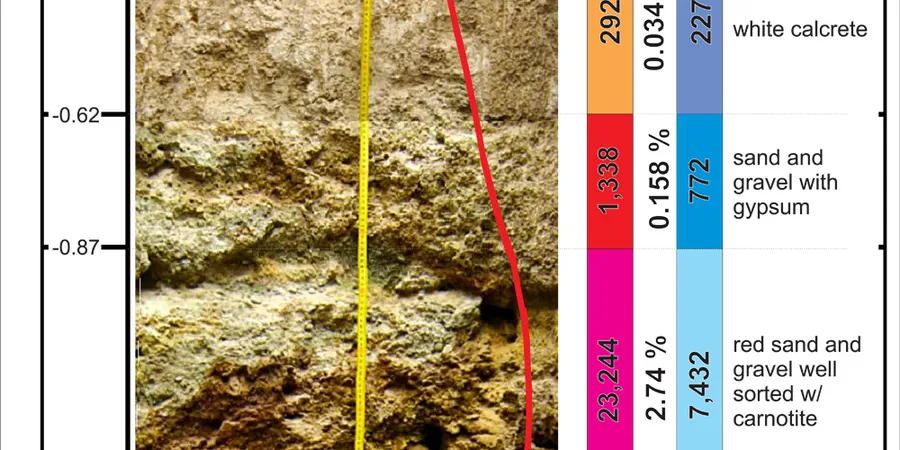
The pit wall also reveals structural defects invisible in borings: desiccation cracks, krotovinas, and buried organic horizons that compromise bearing capacity. We photograph the entire face with a scale bar and GPS-tag each exposure for the final report. Contractors use these logs directly for excavation support planning and utility-trench stability assessments.
Local considerations
Omaha sits at roughly 1,090 feet elevation on dissected loess-mantled hills that drain toward the Missouri River. The 2011 flood and subsequent groundwater rebound revealed how quickly saturation destabilizes these collapsible soils. Skipping a test pit on a commercial lot in the Old Market area, where up to 8 feet of historical fill overlies buried foundations, means risking differential settlement that insurance will not cover. Our crew has uncovered brick-lined cisterns, abandoned coal chutes, and uncompacted ash fill that did not appear on any city record. A single undocumented void beneath a footing excavation can delay a project three weeks and add five figures in change orders. IBC Chapter 18 requires adequate subsurface exploration: a test pit provides the visual evidence that a boring log alone cannot.
Applicable standards
ASTM D2488 (visual-manual soil classification), ASTM D1556 (sand cone density), IBC 2021 Chapter 18, OSHA 29 CFR 1926 Subpart P (excavation safety)
Associated technical services
Stratigraphic exposure and logging
Excavation with 20-ton or 8-ton excavator depending on access; continuous visual logging of the exposed face, measurement of layer thickness, and identification of fill, loess, till, and bedrock contact.
In-situ density and sampling
Sand cone density tests (ASTM D1556) at footing grade and fill lifts; bulk sampling for moisture content, grain-size distribution, and Atterberg limits when fine-grained soils are present.
IBC-compliant report with photo-log
GPS-referenced pit location, scaled wall photographs, USCS classification of each stratum, field vane shear strength on cohesive layers, and recommendations for allowable bearing pressure and excavation support.
Typical parameters
Frequently asked questions
How deep can you excavate a test pit in Omaha without hitting refusal?
In the loess-mantled uplands west of downtown, refusal on glacial till or Pennsylvanian shale typically occurs between 12 and 18 feet. East of 72nd Street in the Missouri River floodplain, sand and gravel layers may limit depth to 10 feet due to caving. We bring a 20-ton excavator with a long-reach arm that can achieve 14 feet in stable loess; beyond that depth, OSHA shoring requirements and trench stability make a borehole program more practical.
What does an exploratory test pit cost in the Omaha metro area?
The typical range for a single test pit with logging, in-situ density, and a report runs from US$440 to US$940, depending on depth, access constraints, and the number of samples collected. Sites requiring traffic control, street-cut permits, or hydraulic shoring fall toward the upper end. We provide a fixed price after reviewing the site plan and desired depth.
Can you backfill the test pit and compact it for a building pad?
Yes. We backfill in 8-inch lifts with moisture-conditioned lean clay, compacting each lift with a vibratory plate or jumping-jack tamper to 95% of standard Proctor maximum dry density. For areas that will receive footings or slabs, we test each lift with a sand cone and document compaction in the report. CLSM backfill is available as an alternative for utility trenches or confined spaces where mechanical compaction is not feasible.